
The Anxiety Is Real
Before we get to the maths, it is worth acknowledging why this question is being asked at all. Youth climate anxiety is not a media invention or an overreaction. It is well-documented, persistent, and increasing.
The most comprehensive survey to date, published in The Lancet Planetary Health in 2021, surveyed 10,000 young people aged 16-25 across ten countries including the UK and US. Nearly 60% described themselves as very or extremely worried about climate change. More striking: over 45% said those feelings adversely affected their daily functioning - their sleep, their ability to concentrate, their sense of the future.1
A 2025 study in the Proceedings of the National Academy of Sciences, surveying nearly 3,000 US teenagers and young adults, found that approximately 20% were afraid to have children because of climate change - a figure that rose above 30% among young people who had directly experienced a severe weather event.2 A separate 2024 Lancet survey of 16,000 young people across all 50 US states found that nearly 62% had tried to talk to adults about climate anxiety and over 57% felt ignored or dismissed when they did.3
A 2025 academic review in the Annals of the New York Academy of Sciences found that while climate anxiety is real and widespread, it ranked below financial worries, health concerns, and job security as the primary source of stress for UK young people aged 16-29. Fewer than 1 in 10 showed levels that could be described as moderate or severe.4 The picture is one of genuine and widespread background concern, not universal crisis - but that concern is motivating real behaviour change, including practical acts like the one we are about to examine.
This context matters because it shapes what kind of action is actually helpful. Climate psychologists consistently find that concrete, controllable actions reduce anxiety more effectively than abstract awareness. Knowing about the problem without being able to do anything about it is what produces helplessness. Doing something - even something small - changes the feeling.
So: would a bedroom battery bank actually do something?
The Idea, Explained
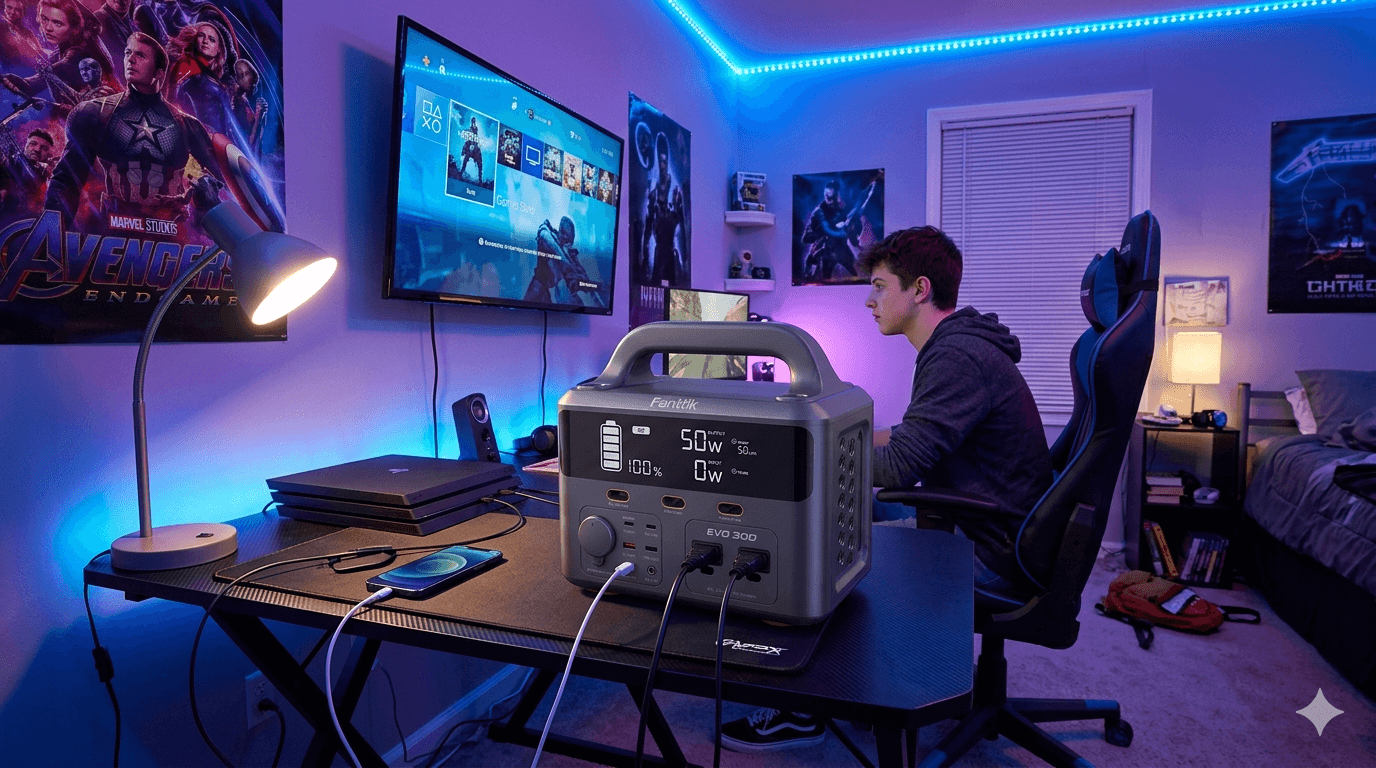
The concept is straightforward. You buy a portable power station - the kind marketed for camping and power cuts - in the 1-2 kWh capacity range. You charge it overnight on a time-of-use tariff: in the UK that means something like Octopus Go (7.5p per kWh, 00:30-05:30, against a daytime rate of around 27p - Smart meter required); in the US the closest equivalent is Octopus Flex in Texas (roughly 7-9¢ per kWh overnight, 10pm-6am, against peak rates of 18-25¢ - Smart meter required), or a utility TOU tariff like PG&E's EV2-A in California. During the evening peak - say 4pm to 9pm - you run your TV, games console, monitor, phone charger and bedroom lights from the battery instead of directly from the grid. The battery discharges. Overnight it fills up again. On a standard flat-rate tariff this doesn't work financially - you need the cheap overnight window to make the arbitrage worthwhile, which means getting the household onto a smart tariff first.
The grid cares about this because those evening hours are when demand is highest. It is when gas peaker plants are called on to fill the gap between what wind and solar generate and what the country actually needs. Every household that reduces its demand during that window - even slightly - means fractionally less gas being burned. Multiplied across millions of teenagers with birthday presents they actually use, that adds up.
What Does a Typical Bedroom Setup Draw?
Before calculating anything, we need a realistic picture of what's actually being powered. A gaming PC or console, a monitor or TV, and a desk lamp together draw roughly 150-350W depending on the hardware. Running that for five peak hours uses 0.75-1.75 kWh. A 1 kWh portable battery covers the conservative end of that comfortably; a 2 kWh unit covers almost any setup with room to spare.
What Does One of These Cost?
This is where things have genuinely changed in the last two years. The portable power station market has been driven down by Chinese manufacturers and fierce competition at Amazon. Units that cost £400-600 in 2022 can now be found for under £200 on sale, and prices continue to fall.
Current Market - UK
Current Market - USA
For this analysis we will use a 1 kWh unit at £300 (UK) / $350 (US) as a realistic, achievable purchase price - conservative enough to account for buying outside a sale, and representative of well-reviewed LFP (lithium iron phosphate) units that will last 3,000+ charge cycles.
The CO₂ Calculation
This is the important question. Does shifting your bedroom usage from peak to overnight actually reduce carbon emissions, or does it just shuffle the same electricity around?
The answer depends on one crucial fact: overnight electricity in the UK and USA is significantly cleaner than evening electricity. When you run your TV at 7pm on a dark winter evening, the grid is likely pulling on gas power stations to meet demand (these are known as 'peakers', and are kept in reserve to run only during peak hours). When you charge your battery at 2am, the grid is running on base load - nuclear and hydro - supplemented by whatever wind is blowing. In the UK, the average grid carbon intensity at overnight off-peak hours is roughly 30-50% lower than during the evening peak.5
We assume 1 kWh shifted daily from peak (approx. 250g CO₂/kWh evening) to overnight (approx. 150g CO₂/kWh, lower due to wind and reduced gas). Net saving: ~100g CO₂ per kWh shifted. Less roughly 5-10% battery round-trip loss: effective saving ~90g CO₂/day. Over 300 days/year (allowing for holidays, nights away, inconsistent use): approximately 27 kg CO₂ per year.
The US grid is more carbon-intensive overall, but the peak/off-peak differential is similar in percentage terms. Evening peak: approx. 400g CO₂/kWh (varies significantly by state). Overnight: approx. 280g CO₂/kWh. Net saving per kWh shifted: ~120g. Less round-trip loss: ~108g/day. Over 300 days: approximately 32 kg CO₂ per year.
To put those numbers in context: 27-32 kg of CO₂ per year is roughly equivalent to driving 100-120 miles in a petrol car, or about three return flights from London to Edinburgh. It is not nothing. It is not enormous. It is a real, measurable reduction.
The Money Calculation
Now the part that might actually determine whether this happens. If your household is on a standard tariff, there is no financial benefit to shifting usage - you pay the same rate all day. But if the household switches to a time-of-use tariff, the picture changes considerably.
The UK payback period of around five years assumes the household is on Octopus Go or a similar time-of-use tariff - which requires a smart meter. Without one, the financial case is much weaker. In the US, Octopus Energy operates as Octopus Flex - currently available in Texas - offering off-peak rates from 10pm to 6am that create a similar arbitrage opportunity to the UK product.8 California's utility time-of-use tariffs (PG&E, SCE) also deliver comparable spreads. Flat-rate states without TOU options offer much less incentive until their pricing structures change.
The honest picture: this is not a fast-payback investment. But it is a reasonable one for a device that also provides backup power during outages, is genuinely useful for camping or garden use, and will last a decade. The CO₂ savings are real if modest. The money savings require a smart tariff.
Level Up: Pairing the Battery With Plug-In Solar ☀️
The overnight-to-evening arbitrage described above is how most bedroom battery banks get used today. But there is a second, more powerful strategy that is becoming realistic in the UK right now: charging the battery from plug-in solar panels during the peak sun window - roughly 10am to 3pm - and then using that stored solar in the evening, exactly as described above. One battery. Two jobs.
Plug-in solar (sometimes called balcony solar) was formally legalised in the UK in March 2026, with BS 7671 Amendment 4 published on 15 April 2026. A BSI product standard is expected around mid-July 2026, after which mainstream retailers should stock certified kits. An 800W panel kit starts at around £349 (EcoFlow STREAM). A G98 notification to your DNO is required within 28 days of installation - a free online form, no approval needed. See our full UK plug-in solar guide for current legal status, available kits, and the DNO finder.
Here is why a battery transforms the maths. A typical 800W kit in the UK generates around 500-700 kWh per year. On a decent sunny day in summer, it can produce 2-3 kWh between 10am and 3pm. Without a battery, anything above your household's instant consumption at that moment is exported to the grid - for free, since plug-in solar cannot yet access the Smart Export Guarantee. There is no SEG pathway for DIY plug-in installs until around 2027. With a 1 kWh battery connected, that midday surplus is captured and sitting ready for your evening peak.
An 800W kit generating ~600 kWh/year of zero-carbon electricity displaces approximately 120 kg CO₂/yr compared to drawing the same energy from the grid. When the battery stores midday surplus and shifts it to the evening peak - when gas peakers are most active at roughly 250g CO₂/kWh - each stored kWh avoids more carbon than average grid electricity. Battery + solar combined: roughly 130-150 kg CO₂ per year. That is around five times the battery-alone figure, and comparable to skipping two short-haul return flights.
Direct solar self-consumption during the day saves around £70-150/yr at current unit rates (24.5p/kWh), depending on how much of your generation you use in real time. The battery then captures the midday excess that would otherwise be wasted - roughly 0.5-1 kWh on a good solar day across ~150-180 usable days per year - worth an additional £20-40/yr. In winter and on overcast days, the same battery charges overnight on the cheap Octopus Go rate and discharges in the evening as described above, adding roughly £20-30/yr on winter nights. Combined annual saving: approximately £110-220/yr for a household running an 800W kit, a 1 kWh battery, and an Octopus Go tariff.
The seasonal rhythm is what makes this combination work so cleanly. From roughly April to September, the battery charges from sunshine during the day and discharges into your bedroom in the evening. From October to March - or on any overcast day year-round - it charges overnight on the cheap rate instead. The battery is always doing something useful. The solar and the tariff strategy are complementary rather than competing.
One practical note: to connect a standalone portable power station to a plug-in solar panel kit, you need a unit that accepts a DC solar input (most 1 kWh+ portable stations do, via MC4 or an XT60 adapter). Alternatively, integrated kits like the EcoFlow STREAM Solar Plant bundle the panels and battery into a single 13A plug-in system - currently listed from £1,199 for the 1.92 kWh battery unit, with panels sold separately. If you are starting from scratch and want both functions in one purchase, the integrated kit is simpler; if you already have a portable power station and want to add panels later, check the DC input specs before buying panels.
Does It Actually Help the Grid?
We have been building the case in terms of one bedroom. The more interesting question is what happens if enough teenagers - or enough households - do this.
The UK has approximately 28 million households. If 5% of them - about 1.4 million - each ran a 1 kWh battery bank daily, the aggregate peak demand reduction would be roughly 1.4 GWh of demand shifted out of the evening peak window. At a typical demand reduction of 200-300 MW during the critical 5-7pm slot, that is comparable in scale to a small gas peaker plant's daily output.
This is exactly the kind of distributed demand response that grid operators want to see more of. The UK's National Energy System Operator has explicitly identified residential demand flexibility as one of the most cost-effective tools for reducing peak gas generation. As our recent article on the grid battery storage scandal noted, even large-scale batteries face institutional barriers to being used properly - distributed residential storage, by contrast, simply responds to price signals with no system integration required.
"Individual actions can improve wellbeing in the short term - but the research suggests their greatest value may be as a gateway to collective action rather than as an end in themselves."
Tapia-Echanove et al., WIREs Climate Change, 2025 - reviewing 80 studies on youth climate behaviour6This is the deeper answer to the climate anxiety question. A bedroom battery bank saves a real but small amount of carbon. It saves a modest but real amount of money on the right tariff. But its most important function may be neither of those things. Doing something concrete - understanding why and how it works, talking about it, being the person at school who actually gets a smart tariff - is how individual concern becomes household change, and household change becomes the kind of social norm that precedes policy change.
The Honest Verdict
The planet does not need perfect solutions. It needs millions of adequate ones, pursued by people who have moved from anxiety into action. A battery bank under the Christmas tree - or on the birthday list - is a small, real, repeatable, transferable action. Pair it with a couple of solar panels on the south-facing window ledge and it becomes something more: a tiny household power station that runs on sunshine in summer and cheap overnight wind in winter. That is more than most birthday presents manage.
Sources & References
- Hickman C. et al., "Climate anxiety in children and young people and their beliefs about government responses to climate change: a global survey," The Lancet Planetary Health, December 2021. 10,000 participants, aged 16-25, across 10 countries.
- Vercammen A. et al., "Psychological impacts of climate change on US youth," PNAS, April 2025. Survey of ~3,000 US young people aged 16-24.
- Lewandowski R. et al., "Climate emotions, thoughts, and plans among US adolescents and young adults," Lancet Planetary Health, 2024. Survey of ~16,000 young people across all 50 states.
- Ogunbode C.A. et al., "Climate Anxiety in Perspective: A Look at Dominant Stressors in Youth Mental Health and Sleep," Annals of the New York Academy of Sciences, 2025.
- National Energy System Operator (NESO) half-hourly carbon intensity data; Carbon Intensity API (carbonintensity.org.uk); BEIS Electricity Generation Costs 2023.
- Tapia-Echanove et al., "Climate Change Cognition, Affect, and Behavior in Youth: A Scoping Review," WIREs Climate Change, February 2025. Review of 80 studies on youth climate behaviour and individual action.
- Octopus Energy, Intelligent Octopus Go tariff rates, March 2026. Standard variable tariff data from Ofgem price cap April 2026 (24.67p/kWh). EcoFlow UK pricing: uk.ecoflow.com, March 2026. Anker Solix pricing: Amazon UK, March 2026.
- Octopus Energy US, "Octopus Flex - time-of-use energy plan," octopusenergy.com/octopusflex, March 2026. Off-peak hours 10pm-6am; $200/yr average household saving quoted by Octopus for customers who actively shift usage. Currently available in Texas.
- 4 Billion Years On, "UK Plug-in Solar Guide 2026 — Legal Status, Kits, Payback & Batteries," 4billionyearson.org/plug-in-solar-uk, updated daily. BS 7671 Amendment 4 source: IET/BSI, 15 April 2026. EcoFlow STREAM pricing: uk.ecoflow.com, May 2026. Solar yield estimates: PVGIS regional data for UK.