
UK Plug-In Solar will be legal on 27 August … It’s ALMOST clear what you can and can’t install
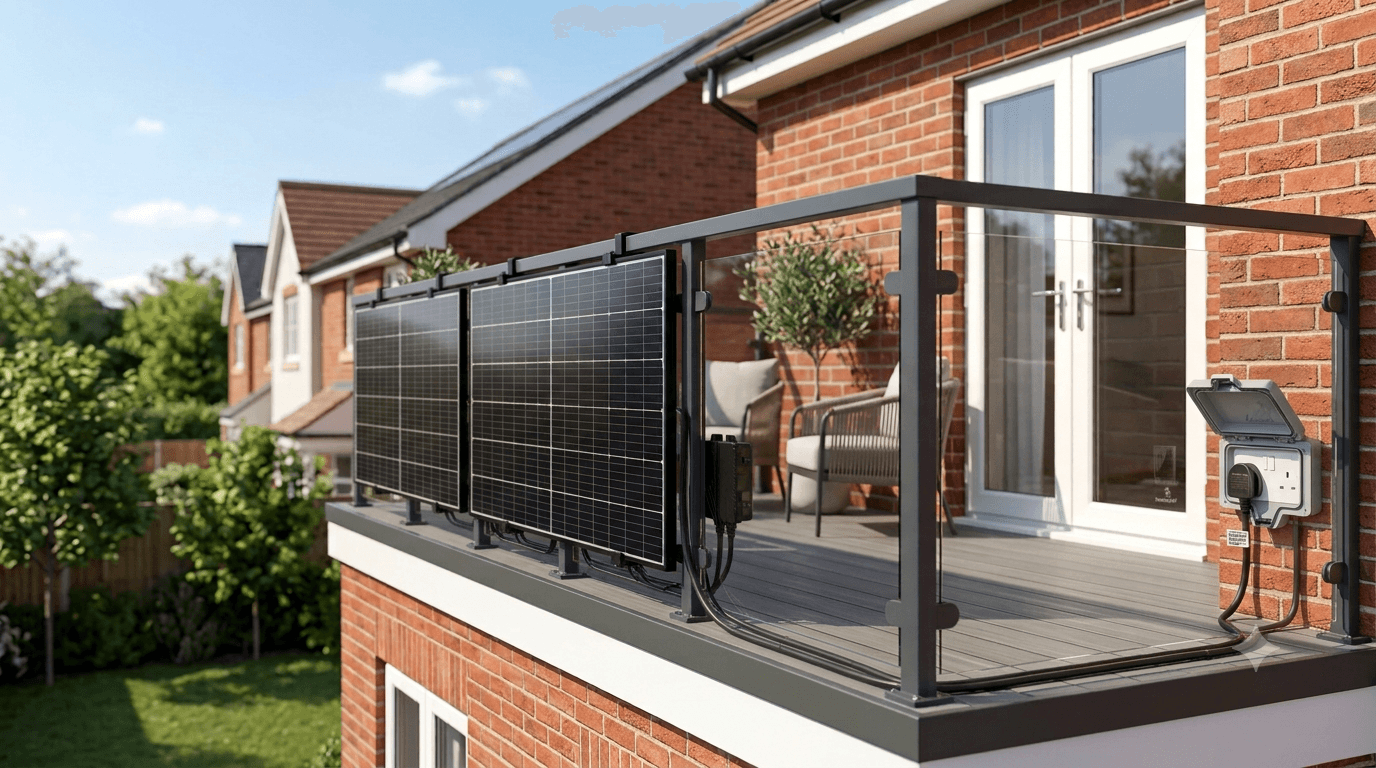

Back in March we called this the "Middle of Lidl" revolution, on the strength of an announcement and not much else. Four months later and there's a statutory instrument with a number and a commencement date. On 27 August 2026, UK plug-in solar stops being a grey area and products will be available in the shops. Well, almost ...
Not quite as simple as "buy a kit, plug it in." Here's what's actually confirmed, and where the gaps are ...
The short version
27 August 2026
SI 2026/848 comes into force. It creates a legal category, "plug-in microgenerator", lets a standard BS 1363 3-pin plug be approved for feeding power into a socket, and makes DESNZ's Interim Product Specification (IPS v2) a legal requirement. 800 Watts max. Solar only.
- Complete kits only. The specification certifies a whole product ... panel, inverter, factory-fitted cable and plug, mounting system ... not an inverter plus panels that you sourced separately.
- One device per circuit, but the 800 W network rules still say per household. The IPS moved to one 800 W device per final ring main circuit on July 16th. G98, which actually governs your DNO connection, still caps it at 800 W per household. Until G98 is amended (no timescale), 800 W per household is the real limit.
- The spec says "final ring circuit". Ring main circuits are standard in most UK housing, but plenty of newer installs use radial circuits instead. The wording doesn't obviously account for that, so it's a grey area.
- You can't extend the cable. The AC lead and plug are factory-fitted and can't go through an extension lead or adaptor of any kind (no cutting or splicing in extra cable). That limits where you can realistically site the system.
- No cladding, no timber balconies. ACM, MCM, HPL and timber cladding are all excluded outright, along with timber balconies and any building under external wall fire remediation. That excludes a meaningful number of flats.
- Batteries are excluded by definition, not by oversight. The legal wording specifically excludes anything designed to import electricity for storage. Octopus announced a plug-in battery in June anyway (see below).
- There's a battery workaround that needs no permission at all. A portable power station with pass-through sits between your kit and your appliances, outside this entire framework. More below ...
The three documents, briefly
| Document | Owner | Job |
|---|---|---|
| SI 2026/848 | DESNZ / Parliament | The law. Defines "plug-in microgenerator", requires IPS compliance. |
| IPS v2, July 2026 | DESNZ | The technical rulebook. A government document, not a British Standard. |
| G98 Issue 2 Amendment 1 | Energy Networks Association | Network connection rules. What your DNO will actually accept. |
There's no BSI product standard, and there never had been a confirmed date. DESNZ's response says only that work will begin on a longer-term standard, developed with unnamed "standards bodies and stakeholders." No date, no commitment that it will be a BSI.
Per circuit, per household, and the ring main problem
Version 1 of the spec, published in June, said flatly ... one device per household, with the same footnote repeated four times, "may be changed to per circuit depending on outcome of consultation." Version 2, published 16 July, made the change ... one plug-in solar product per household final ring circuit.
A product specification can't override the network connection rules, though, and it says as much itself. G98 Issue 2 Amendment 1 still states one device per household, and the IPS notes this applies "unless and until" G98 is amended. No date for that amendment exists. It has to come through the ENA's engineering governance process with the DNOs and Ofgem, not something a minister can announce.
Practical answer
Treat it as one device per household until G98 says otherwise. "Per circuit" is the direction of travel, not today's rule, whatever the marketing says.
There's a second wrinkle nobody seems to have flagged. The specification's scope clause says one device per household final ring circuit, not just "final circuit." A UK ring final, where sockets are wired in a loop back to the consumer unit, is still the most common arrangement, but it's not the only one. Radial circuits, a single cable run rather than a loop, are increasingly common in newer wiring and are the norm in some other installation styles. Other circuit types, such as lighting and spur circuits supplying fixed equipment (cookers, boilers etc) are specifically excluded though, so radial circuits are perhaps a grey area. Most homeowners will have no idea which type of circuit their sockets are actually wired on.
The requirement for circuit protection is not yet fully clarified, with IPSv2 making limited comment and pointing back to BS7671 ... an RCD is required, one that disconnects all live conductors including neutral, but it doesn't have to be a dedicated RCBO on that circuit. A shared upstream RCD with ordinary MCBs may also be acceptable (e.g. split load board), though that's flagged as still under verification rather than fully confirmed. What the spec doesn't do is specify a minimum RCD type, despite warning elsewhere that plug-in solar can desensitise older Type AC devices with DC leakage.
Where can you actually plug it in?
A plug-in solar device is defined as a complete assembly ... PV module, inverter, and a connection lead fitted by the manufacturer with a BS 1363 plug. That lead is not something you extend. The specification explicitly bans connecting the device to an extension cable, multi-way adaptor or RCD adaptor. Whatever length of cable the manufacturer supplies is the working radius you get.
That has real installation consequences. If you want to site the inverter outside and connect the system to an internal socket, you're going to have to drill a hole in the wall big enough to get a 3-pin plug through. An IP55 rated (waterproof) outdoor socket will be fine, as long as it's connected into a final ring main. The good news for DIYers, if you know what you are doing, is that you are allowed to install an external socket yourself. Either way, this may not be a case of "find a sunny spot and run a lead" for many buyers.
The DC side, between the panel and the inverter, is more flexible. The specification allows the manufacturer to supply routing connectors specifically so a cable can pass from an outdoor panel to an indoor inverter, assembled by the installer rather than pre-fitted. So the workable route for most will be ... panel outside, DC cable routed through a small cable entry point (using a compliant conduit etc), inverter mounted just inside. Manufacturers instructions should give guidelines on suitable places to install the inverter.
Beware those existing 'DIY' shed sockets that may not be wired in properly or protected! There's a good chance your existing shed socket won't be compliant, and running power from your house to a shed is notifiable electrical work requiring an electrician, the exact requirement plug-in solar is supposed to avoid. The "no electrician needed" pitch only holds if you already have a compliant socket in range.
One more limit worth mentioning ... total panel power up to 2,000 W DC is permitted, but the specification recommends professional assessment if above 960 W.
No cladding, no timber balconies
Fire safety rules out more building types than the press coverage has mentioned so far. Installation is not permitted on aluminium composite material or metal composite material cladding, high-pressure laminate cladding, timber cladding, or timber balconies. It's also banned on any building currently subject to external wall remediation or equivalent fire safety work.
Balcony rails and render or brick walls are fine. A meaningful share of post-Grenfell blocks with cladding remediation in progress, and any building finished in timber, are not. For a policy aimed partly at flat dwellers, this is a significant restriction.
Kits, not components
The specification certifies complete systems, not parts. DC connectors have to be factory-supplied matching pairs, adaptors have to be pre-assembled by the manufacturer, Y-connectors are banned outright, and the mounting system needs its own structural analysis against UK wind and snow loading. You can still make the DC connections yourself, kits are explicitly allowed for that, but you can't build your own combination from a separately sourced inverter and panels and call it compliant.
I haven't found evidence in the government's own work that competent self-assembly from compatible parts is actually less safe than the same parts sold as a branded kit. The more likely explanation is enforcement ... "only these certified systems are legal" is a rule Trading Standards can apply. Worth watching whether this loosens once the market matures, the way it did in Germany.
Batteries ... excluded by design ... Octopus didn't wait
The exclusion isn't a gap in the guidance. The legal definition of a plug-in microgenerator in SI 2026/848 specifically excludes anything designed to import electricity from your installation for later storage. That's written into the law itself, not just the specification, which makes it harder to undo than a spec revision.
The safety study behind all of this tested solar inverters. It didn't test batteries, because batteries were never in scope, so there's no UK evidence base yet either way on plug-in battery safety specifically.
This makes Octopus Energy's timing quite interesting. On 22 June, three weeks before the government's final position was published, Octopus announced the Nook Cube ... a 2 kWh battery that plugs into a standard socket, stacks to 10.5 kWh, no installer required. It's due in the UK in 2027, not this year, and it's a standalone battery with no solar panel attached.
A pure battery, charging overnight and discharging at peak, was unlikely to be covered by legislation written around solar generation, so Nook isn't blocked by anything in SI 2026/848 on that basis. Whether discharging stored grid electricity back through a standard BS 1363 plug raises the same underlying question that blocked solar plug-in, a device pushing current out through a socket that was designed only to draw it in, isn't something I've seen tested or settled anywhere. Octopus's own regulatory team would have been aware of this consultation running in parallel with their launch, which suggests either they're confident the two issues are legally distinct, or they're betting the picture opens up further before 2027 arrives. Worth watching to see what happens if you're keen on having a battery.
A battery workaround ...
None of the battery restrictions above apply if the battery doesn't discharge back into your mains.
A portable power station with true bypass sits between the wall socket and your appliance, not between your solar kit and the grid. Plug the power station into the wall, plug your TV or games console into the power station, and leave it that way permanently. During the day, it charges from whatever excess solar your plug-in kit is producing (or from cheap overnight rates on a time-of-use tariff). In the evening, it discharges to run the appliance instead of drawing from the grid. If it runs flat, bypass circuitry lets grid power flow straight through to the appliance without interruption, no need to notice or intervene.
Because the appliance is plugged into the battery, and the battery is what's plugged into the wall, nothing is being exported into the ring main. It isn't a plug-in microgenerator, isn't covered by G98, and needs no DNO notification. It's the same legal category as a laptop charger. This is worth more attention than it's had ... it captures a real share of the peak-shifting benefit that the battery exclusion is currently blocking, entirely outside of the regulatory gap.
How the UK compares to Europe ...
The 800 W figure comes straight from Germany's DIN VDE V 0126-95, the world's first plug-in solar product standard. But the shared number hides a real difference in how the two schemes actually work.
Germany's 800 W is a household cap, not a per-device or per-circuit allowance. It's the combined output of every plug-in device registered at a single electricity meter. You can run several small inverters at once, two on separate circuits adding up to 800 W is fine, but the moment the combined total at that meter goes over 800 W, the whole installation drops out of the simplified scheme entirely and needs a qualified electrician and formal grid operator approval, same as full rooftop PV. Circuits only come in as a secondary rule ... one device per circuit, even if under the 800 W ceiling.
The UK's draft position runs the other way. The IPS sets its own limit at one device per final circuit, with no stated cap on how many circuits a household can use. Read on its own terms, a house with four socket circuits could host 4 × 800 W of combined plug-in capacity, something Germany's meter-level cap would never allow no matter how many circuits it's spread across. Today, the two countries land in the same place in practice, because G98 still limits the UK to one device per household overall. But if G98 is amended to match the IPS's per-circuit position, as seems likely, the UK would move well past Germany's model rather than simply catching up to it.
What to watch out for next ...
- The ENA Type Test Register. No product can be sold until it's listed there. Best real-time indicator of whether kits land in August or drift later. ENA Type Test Register
- The revised G98. Settles per-household versus per-circuit, and possibly the ring versus radial question too.
- First certified products. None announced yet. Hoymiles is worth watching, since most rebranded kits already run its microinverters.
- Whether batteries get their own framework before or after Nook actually ships.
Our UK plug-in solar guide tracks all of this daily, with a payback calculator, DNO finder and landlord letter template.
References
- 4 Billion Years On (2026). The "Middle of Lidl" Revolution: Plug-In Solar is finally coming to the UK.
- Octopus Energy (2026). Small Battery: Octopus Energy launches the "Nook" range.
- VDE / DKE (2025). DKE publishes world's first product standard for plug-in solar devices. DIN VDE V 0126-95:2025-12.
- UK Statutory Instruments (2026). The Plugs and Sockets etc. (Safety) Regulations 1994 and Electricity Safety, Quality and Continuity Regulations 2002 (Amendment) Regulations 2026. SI 2026/848.
- Department for Energy Security and Net Zero (2026). Plug-in Solar Device Interim Product Specification, Version 2.0.
- Energy Networks Association (2026). Engineering Recommendation G98, Issue 2 Amendment 1.