
The Latest Blow: A Stability Auction With No Battery Winners
Three weeks ago, the results of the UK's second Stability Market auction came in. Every single battery storage submission failed at the technical assessment stage. Synchronous condensers and open-cycle gas turbines walked away with 7.3 GVAs of contracts worth tens of millions of pounds. The batteries got nothing.1
This would be unremarkable if batteries hadn't already proven they can do the job. NESO's own Stability Pathfinder programme spent £323 million specifically to demonstrate that grid-forming batteries could provide the inertia and stability services historically delivered by spinning gas turbines. Zenobē's Blackhillock project in Scotland, Europe's largest transmission-connected battery, is right now delivering stability services under a Pathfinder contract. Its sister project at Kilmarnock South is doing the same.2
Yet in Round 2 of the permanent Stability Market - the mechanism meant to replace the Pathfinder pilots - those same proven batteries couldn't get past the technical assessment.
NESO introduced new technical requirements in Round 2, including "fixed H constants" - requiring battery projects to commit to specific, non-variable inertia values during the tender and connection phases. This was not present in Round 1. Batteries, which provide inertia differently from spinning turbines, struggled to meet it. Industry analysts at Modo Energy noted that some of the failing projects are already operational and hold active Stability Pathfinder contracts - meaning NESO's own Pathfinder programme approved them, but its own Stability Market then rejected them.1
Reaction from the storage industry was sharp. Multiple analysts commented that NESO's eligibility criteria appeared "written around incumbents rather than outcomes" - favouring old thermal and synchronous assets over zero-carbon alternatives that have been technically proven.1 A more charitable reading is that NESO is being "reassuringly conservative" about procuring inertia, given how critical grid stability is and how catastrophic a failure would be. Both things can be simultaneously true.
What is not in dispute is the pattern this fits into.
The Older Scandal That Set the Scene
The stability auction is the latest episode in a longer story of institutional systems failing to use the batteries Britain has been building. In September 2024, the chief executives of four energy storage companies published an open letter with a stark finding.
"Our own data - verified by the ESO - shows that batteries are being skipped over 90% of the time during constraint periods for some sites." The companies estimated the cost could reach more than £2 billion per year by 2030. National Grid accepted the criticism and blamed ageing dispatch software that couldn't confirm whether batteries had enough charge to deliver when called upon.3
The mechanism was mundane. When the grid needs flexible assets, it ranks them by price and dispatches accordingly. In theory, batteries are often cheaper. In practice, National Grid's legacy software couldn't confirm a battery's state of charge in real time, so operators defaulted to gas. The result was a chronic subsidy flowing from electricity consumers to gas plant operators for no technical reason.
National Grid launched the Open Balancing Platform in late 2023 to address this, and skip rates fell. The episode established a pattern: the technology runs ahead; the systems governing it lag behind; consumers pay the difference.
A Timeline of Institutional Lag
The Ambition Underneath the Dysfunction
It would be easy to conclude that the UK's battery programme is struggling. The opposite is closer to the truth. The institutional dysfunction sits on top of an extraordinary pace of physical deployment.
grid storage — end 2025
by 2030
connections queue
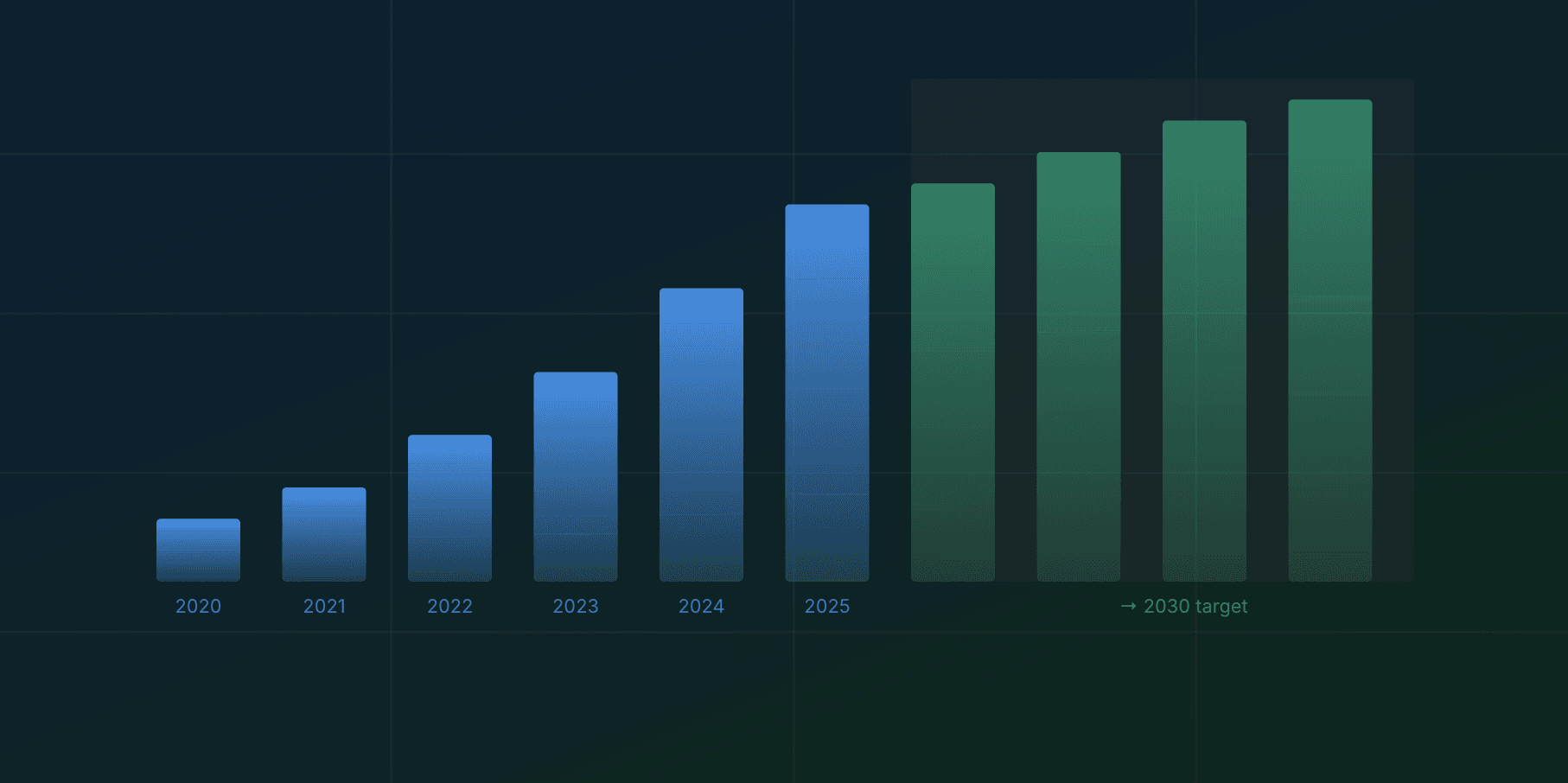
The December 2025 grid connection reforms confirmed a pipeline of 34.5 GW of battery storage prioritised for connection by 2030.4 Developer appetite is striking: 221 GW of projects sit in the queue, nearly ten times the 2030 target. RWE has just committed to a £200m, 350 MW / 700 MWh facility at Pembroke in Wales, construction starting in early 2026.5 The UK's largest single battery, the 600 MWh Thurrock Storage project, came online in late 2025 at Tilbury.6
The constraint is not ambition or capital. It is, as it keeps proving itself to be, the regulatory frameworks designed for a different energy system.
What "Replacing" Gas Peakers Actually Means
The phrase "replacing gas peakers" is almost always imprecise. Britain's gas-fired fleet is not going to be demolished. The government has committed to maintaining 35 GW of unabated gas reserve capacity through 2030 as security of supply insurance.7 What batteries actually do is not shut peakers down but starve them of running hours.
A gas peaker running 1,500 hours per year earns energy revenue for those hours. In a high-battery scenario it might run 300 hours. It still exists, still receives Capacity Market payments to remain available, but its emissions fall sharply and its commercial viability weakens over time. Closure follows commercial unviability, not a policy switch - and that process takes years.
There is also a constraint batteries genuinely cannot solve: duration. A gas peaker can run for twelve hours continuously. A two-hour lithium-ion battery cannot. During a winter period of prolonged low wind - the "dunkelflaute" - batteries can handle hours, not days. This is why a residual unabated gas fleet remains in NESO's plans through at least 2030, probably 2035, and why the Stability Market awards to gas turbines, however frustrating to the storage industry, are not entirely without logic.
What Comes Next
Near Term · 2025-2030
Grid battery deployment accelerates toward the 23-27 GW NESO target. Gas peakers lose running hours but retain Capacity Market payments as reliability insurance. The Stability Market framework is likely to be revised - the industry's reaction to Round 2 was loud enough that NESO will need to clarify technical thresholds for Round 3. Meanwhile, battery revenue from frequency response has already collapsed from 80% to 20% of the typical revenue stack as markets saturate;8 wholesale arbitrage faces the same trajectory.
Medium Term · 2030-2035
More than half the combined-cycle gas fleet could retire by 2035 as running hours fall below commercial viability.9 Long-duration storage - pumped hydro, potentially green hydrogen - begins to address the multi-day reliability gap that lithium-ion batteries cannot fill. This is the honest gap in the decarbonisation roadmap: the technology for seasonal or multi-day storage at scale does not yet exist in deployable form.
Long Term · 2035-2050
NESO's pathways project electricity rising from 20% to 60% of UK primary energy demand. The grid becomes highly distributed and automated, with price signals flowing to millions of flexible assets simultaneously. The defining question of the 2030s is not whether batteries work. It is whether the regulatory architecture catches up fast enough to use them.
What to Take From All This
The Stability Market Round 2 result is not a sign that batteries don't work. It is a sign that the frameworks governing Britain's energy system - the auction designs, the technical specifications, the eligibility criteria - were built for a world of spinning turbines and are being updated one painful episode at a time.
The physical deployment story is genuinely impressive. A 45% capacity increase in a single year. The largest battery in Europe coming online. A pipeline of 221 GW waiting for connection. The technology has moved faster than anyone predicted five years ago.
Set against that: £323 million spent proving batteries can provide stability services, followed immediately by a round in which no batteries win stability contracts. Grid software so outdated it preferred expensive gas to cheap batteries for the better part of two years. A Capacity Market that pays gas plants to exist whether or not they run.
The energy transition is not primarily a technology problem. It is a systems and institutions problem. The batteries are ready. The question is whether the structures designed to use them can catch up quickly enough to matter.
Sources & References
- Energy-Storage.News / Solar Power Portal, "UK: Grid-forming batteries miss out in system stability tender as synchronous condensers, gas get contracts," energy-storage.news, March 2026. Also: Electrical Review, March 6, 2026.
- NS Energy Business, "Blackhillock Launches: UK's First Grid-Forming Battery," February 2026. Zenobē Blackhillock and Kilmarnock South Stability Pathfinder projects, total programme value £323m.
- Energy Storage News, "Battery companies claim UK utility National Grid skips their sites for gas peaker plants over 90% of time," ess-news.com, September 18, 2024.
- NESO, "NESO implements electricity grid connection reforms," December 8, 2025. Cornwall Insight, "Battery Storage Connection Queue Double the Grid's Requirement for 2030."
- RWE, "RWE to build its largest battery energy storage facility in the UK," press release, December 2025.
- National Grid, "National Grid connects UK's largest battery storage facility at Tilbury substation," 2025.
- Department for Energy Security and Net Zero, "Clean Power 2030 Action Plan," December 2024. UK Parliament Hansard, Gas-Fired Power Stations debate, March 13, 2024.
- Modo Energy, Q4 2023 Update. Frequency response revenue collapse from 80% to 20% of revenue stack, 2022-2024.
- Timera Energy capacity market analysis; DESNZ gas plant retirement modelling 2024.