
North Atlantic Oscillation
The pressure see-saw behind UK and European winters - mild and stormy, or cold and still…
The pressure see-saw between the Icelandic Low and the Azores High - the single most important driver of UK and European winter weather. In its positive (+NAO) phase a strong westerly jet drives Atlantic storms into northern Europe; in its negative (-NAO) phase the jet buckles south and lets Arctic air in. With the live NOAA daily index, 75 years of monthly history and the Atlantic Multidecadal Variability (AMV) ocean background.
Current State
Icelandic Low vs Azores High: strongest in winter (Nov-Mar) - between seasons, context rather than a forecast.
NAO phase - latest
Positive (+NAO)
+0.77 · 2026-10-14
30-day rolling mean
+0.53 · 2026-09
N.North Atlantic
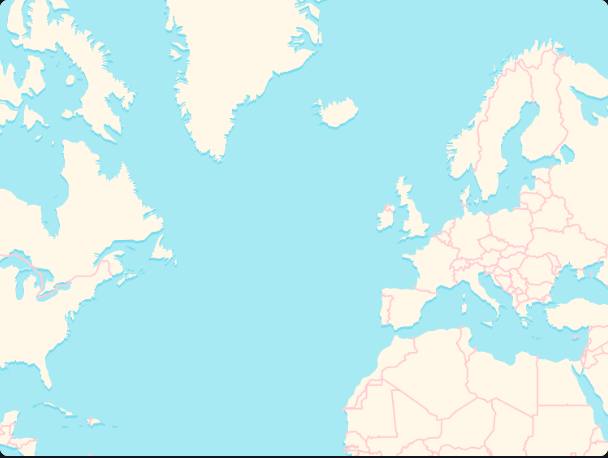
Azores High and Icelandic Low are the two NAO action centres - their pressure difference defines the index. The shaded box is the AMV domain (0-60°N, 80°W-0°); rose = warm phase, sky = cool phase.
NAO phase - latest
Positive (+NAO)
+0.77 · 2026-10-14
30-day rolling mean
+0.53 · 2026-09
Atlantic Multidecadal Variability
AMV (also called the Atlantic Multidecadal Oscillation, AMO) is the slow 20-40 year warm/cool baseline of the North Atlantic. Warm-AMV decades tilt the NAO positive on average and supercharge Atlantic storms; cool-AMV decades favour more blocking and -NAO episodes.
Sustained sign flip detected
NAO crossed from negative to positive on 2026-10-02 and has held the new sign for at least five days. This often marks a genuine jet-stream regime change rather than weather noise.
Thresholds: ≥ +0.5σ Positive · ≤ -0.5σ Negative · otherwise Neutral. Data: NOAA CPC daily NAO - monthly NAO - NOAA PSL AMO/AMV.
History
Daily & Monthly NAO
Daily swings within winters, and the monthly regime shifts since 1950.
Note the +NAO 1990s and the -NAO blocking of 2009-13. NOAA derives the index from 500 hPa heights (rotated principal components). Data: NOAA CPC daily NAO · monthly NAO.
Ocean Background
Atlantic Multidecadal Variability (AMV)
The 20-40 year warm/cool swing in North Atlantic sea temperatures that tilts the NAO and hurricane activity over decades - often linked to the AMOC.
Smoothed (latest)
+0.17°C
2017 · low-pass filtered
Unsmoothed (latest)
+0.19°C
Jan 2023
Phase start
2000
last sign change in smoothed series
Bands: the accepted warm and cool periods (Enfield et al. 2001; Trenberth & Shea 2006). Grey: annual North Atlantic SST anomaly; violet: the smoothed series that sets the phase. NOAA PSL’s Kaplan-SST file runs to Jan 2023 (annual to 2022), and smoothing lags it ~5 years more. Data: NOAA PSL AMO long monthly series.
Regional Impacts
Where Does the NAO Bite Hardest?
Each region's usual winter (Nov-Mar) response to each NAO phase, with today's phase shown first - in high summer the UK rainfall signal flips.
Live: +NAO today · transition season
The index is positive, but NAO weather impacts are strongest in winter (Nov-Mar), with a weaker, different-signed high-summer pattern (Jul-Aug). In the transition seasons the link between the index and UK/European weather is loose - treat today's phase as context rather than a forecast.
AMV background modulator
Warm-AMV background amplifies +NAO storminess and weakens -NAO cold spells across northern Europe.
Positive NAO (+NAO) · winter
- UK, Ireland, Scandinavia, N. GermanyMild · wet · windy wintersStrong westerly jet drives Atlantic storms across the British Isles into mainland Europe. Flooding risk elevated.
- Mediterranean, Iberia, N. AfricaDrier · coolerStorm track pushed north; subtropical high dominates. Worsens drought stress in already dry years.
- Eastern US, SE CanadaMilder wintersFewer cold-air outbreaks; coastal storms tend to track further offshore.
- Greenland, NE Canada, LabradorColder · snowierReinforced trough over Baffin Bay channels Arctic air south.
Negative NAO (-NAO) · winter
- UK, Ireland, Scandinavia, N. GermanyColder · stiller · snowierBuckled jet allows Arctic air to plunge south. High-latitude blocking patterns dominate.
- Mediterranean, Iberia, N. AfricaWetter · stormierStorm track diverted south; episodic flooding around Atlas, Pyrenees and SE Spain.
- Eastern US, SE CanadaCold outbreaks · Nor’eastersPolar air discharges south more often. Snowstorms hit the eastern seaboard harder.
- Greenland, NE CanadaRelatively mildReduced trough lets Atlantic air reach high latitudes. Greenland melt season starts earlier.
Composite from Hurrell (1995, Science), Scaife et al. (2014, GRL) and Met Office GloSea seasonal-forecast verification; summer NAO relationships from Folland et al. (2009, J. Climate). Stratospheric sudden warmings often precede sustained -NAO episodes by 2-4 weeks - see the Stratospheric Polar Vortex tracker for the upstream signal.